The sweat glands on the palms of human hands are only triggered by nervousness.
Not by heat, or physical exertion or anything else.
So sweaty palms on someone are a very clear signal that there is something on their mind.
Showing posts with label Science. Show all posts
Showing posts with label Science. Show all posts
Monday, July 19, 2010

Sunday, June 6, 2010
Some Interesting Fingers

Hey, there's something wrong with that hand...
It has no thumb!
What's that you say? There's too many fingers? Oh yeah, well that too. That's probably from some form of polydactyly.
Sunday, April 18, 2010
You Don't Mess With The Orca
As a recreational writer with the occasional journalistic tendency (that is, I blog every now and then), I am often bothered by the way news is reported, whether in written form or on the six o'clock bulletin. In my opinion, the two biggest errors in journalism are over-sensationalisation of stories, and misleading headlines. Especially when the two are combined, usually with scientifically inaccurate statements and illogical assumptiosn from misunderstood statistical data. That's what really irks me. But anyway. I found an example of this on Thursday in the following article:
 When I saw that headline, I was quite surprised. The accepted models of cetacean behaviour usually dictate that orca (Orcinus orca) prey on whales, not the other way around. The term "killer whale" for orca actually came from the name "whale killer", which arose from the fact that they... kill whales. Groups of orca can take down blue whales, the world's largest animals, by working as a team and ripping out their tongues. There's not a lot that can stand up to an orca. Seals, sharks and dolphins are all fair game for them.
 Pseudo orca (Pseudorca crassidens, or false killer whales) are fairly average-looking porpoise-like critters, smaller than orca but bigger than dolphins. Sort of black in colour. Like real orca, they're members of the dolphin family (Delphinidae). No matter what you define a "whale" as, orca and pseudo orca have the same degree of whaleness. You can't refer to pseudo orca as "orca" if there are real orca in the same situation! That's like telling a story about a sea lion being attacked by a real lion, and saying that "a cat attacked a lion. Although lions are cats, sea lions are not lions, and pseudo orca are not orca.
The moral of the story is that I really, really dislike inaccurate, misleading or ambiguous reporting of facts. Not just in journalism. People do it all the time. My request to those of you that do: stop it.
There's one more lesson to be taken away from this though, and that is that orca (Orcinus orca) are quite good at killing stuff. Don't try to pick a fight with one.
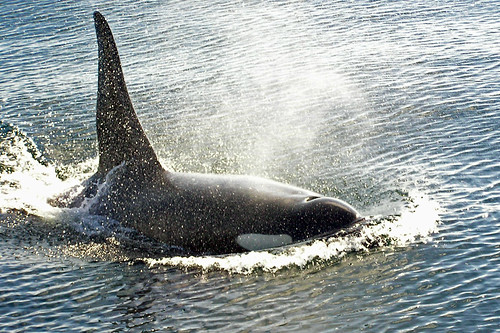 When I saw that headline, I was quite surprised. The accepted models of cetacean behaviour usually dictate that orca (Orcinus orca) prey on whales, not the other way around. The term "killer whale" for orca actually came from the name "whale killer", which arose from the fact that they... kill whales. Groups of orca can take down blue whales, the world's largest animals, by working as a team and ripping out their tongues. There's not a lot that can stand up to an orca. Seals, sharks and dolphins are all fair game for them.
So I wondered what sort of whale would "make a meal" of an orca. I clicked the link to find out and was dissapointed by the opening sentence/paragraph:
"A boatload of tourists got to witness nature at its most brutal when a killer whale flicked a pseudo orca high into the air, broke its back and ate both it and its calf in the Bay of Islands yesterday."
Now, that headline said that a whale killed an orca.
No it didn't!
An orca killed a whale!
That's an important distinction!
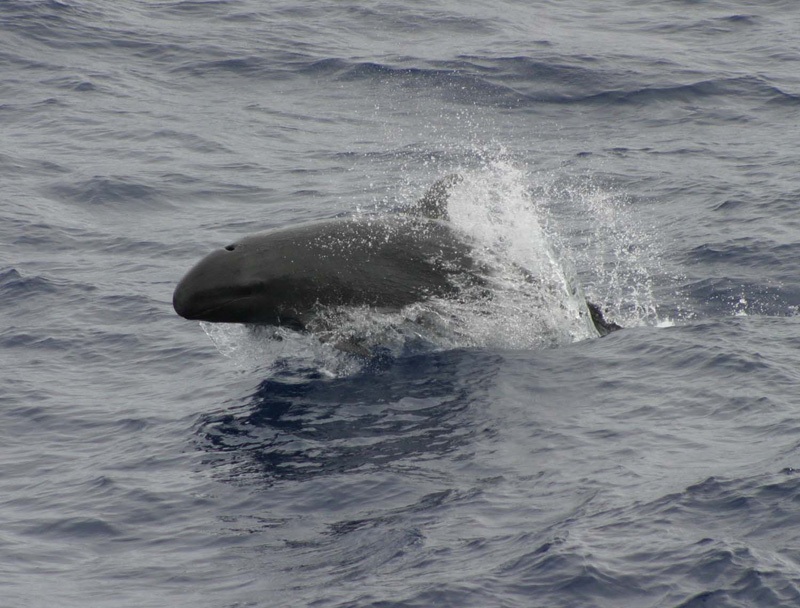 Pseudo orca (Pseudorca crassidens, or false killer whales) are fairly average-looking porpoise-like critters, smaller than orca but bigger than dolphins. Sort of black in colour. Like real orca, they're members of the dolphin family (Delphinidae). No matter what you define a "whale" as, orca and pseudo orca have the same degree of whaleness. You can't refer to pseudo orca as "orca" if there are real orca in the same situation! That's like telling a story about a sea lion being attacked by a real lion, and saying that "a cat attacked a lion. Although lions are cats, sea lions are not lions, and pseudo orca are not orca.
The moral of the story is that I really, really dislike inaccurate, misleading or ambiguous reporting of facts. Not just in journalism. People do it all the time. My request to those of you that do: stop it.
There's one more lesson to be taken away from this though, and that is that orca (Orcinus orca) are quite good at killing stuff. Don't try to pick a fight with one.
Tuesday, January 19, 2010
Something Interesting About The Kilogram
You may or may not have heard, but there is an object in this world which is "the kilogram".
"Nonsense", you may say. "A kilogram is the weight of a litre of water".
"Nay", I reply, "The kilogram is a cylinder with a height and diameter of 39.17 millimetres, made of a platinum and iridium alloy (90% platinum to 10% iridium), known as the International Prototype Kilogram, which is stored in an environmentally monited safe in the lower vault of the basement of the International Bureau of Weights and Measures's House of Breteuil in Sèvres on the outskirts of Paris, with six sister copies. The vault can only be opened by three independently controlled keys (much like the urban legends concerning the formula for Coca-Cola)."
"Cor blimey!" you might reply, with a stunned expression.
"That's not all!" I respond with a grin. "The modern IPK is not the original kilogram - the original "kilogram", or the Kilogram of the Archives, was a cylinder made of solid platinum - but the IPK's mass has been found to be indestinguishable from that of the Kilogram of the Archives - which was made ninety years earlier."
"Wow. That's impressive."
"That's SCIENCE!"

Something Interesting About Holding Your Breath
Have you ever noticed that when you swim underwater, you can hold your breath for much longer than if you were just sitting above water not breathing?
This is because of a physiological response known as the mammalian diving reflex. When cold water (lower than 21 degrees Celsius) touches your face, changes happen in your body that allow you to hold your breath for longer. Let me just break from my professional tone for a moment:
THAT IS SO COOL!!!!
The human body never ceases to amaze me.
(Warning - jargony biology-talk ahead)
I particularly like this because it supports the idea that humans retain features that are adaptations to an aquatic lifestyle, whether from the primordial soup that all life on earth evolved from, or whether humans as we know them - bipedal apes - once lived in a soggy environment that selected for features such as our down-turned nostrils and the webbed fingers and toes that some people still retain (I have heard of people being born with non-functional gills below the skin of their necks too, but this is probably related to the primordial-soup origins). Some biologists argue this aquatic origin theory passionately, saying that our long, muscular legs first evolved for swimming, and became useful for running later, after our wet habitat dried out, an idea I quite like on the basis of whimsy but one that I have not yet committed to in terms of scientific belief.
Subscribe to:
Posts (Atom)


